|



| |
|
|
|
Placencia |
|
|
|
Click on picture to
enlarge image. Click Back to return to text |
|


 |
|
The Moorings charter
yacht base is
in Placencia, some 150 miles south of Belize City.
We were due to fly from Jacksonville in Florida, (50 miles
south of Brunswick), to Miami and connect to Belize on American Airlines on
11th May. Made a 5am start from Brunswick and drove to Jacksonville.
Checked in for the 0820 flight to Miami. 0900 no news on the flight. 0915, tyre problem, replacement due in at 1400 so flight cancelled. Returned to
check in to re-book. A THREE HOUR QUEUE to re-book meant we missed every
flight that day. We finally reached Miami at 9pm, where at least we were
offered hotel accommodation. Arrived Belize a day late on 12th May.
Decided in our wisdom to see something of the personality
of Belize and take the local "chicken market" bus to Placencia. A 5 hour
trip!
Had to wait a couple of hours for the next bus, so had a
quick walk around Belize City. Came to the conclusion that it has very
little to offer.
Sure enough, our bus stopped hundreds of times at every little
village and farm. We had chickens on board, dogs on board and every flavour
of Belize society. Belize is made up of people of Latin American Indian,
Spanish and African origin. Add to this a few more recent European and North
American mixes, some resident ex-patriates and back-packing tourists.
The journey on the bus took us inland to Belmopan, the
capital of Belize then back towards the coast and onto the peninsular of
Placencia. On the way, we travelled through lush rain forest and many
farming areas. Bananas and Oranges are Belize's main agricultural exports.
Many farms are run by Mennonite farmers who came from Europe in the 1950's
and still live their very simple traditional lives.
We arrived Placencia after dark and had trouble finding
our booked accommodation at Capt. Jak's. When we did find it, they had given
up waiting for us and gone for dinner. Eventually the owner turned up and we
moved in.
Placencia is primarily a fishing village. It offers an
enormous sheltered lagoon between it's peninsular and the mainland, hence
the attraction to charter operators who can move their boats quickly up the
lagoon and into the mangrove in the event of storms or hurricanes. Otherwise
the predominant tourists there are back-packers, divers and snorkellers and
the accommodation is all guest houses, no major resorts.
Restaurants are all simple thatched shacks on the beach as
are the bars. There is one narrow main road down the peninsular and
Placencia's famed "Sidewalk" a 1 metre wide concrete path that winds its way
down the beach, parallel to the road, passing all the restaurants, bars and
gift shops.
You walk everywhere as Placencia is far too small to
warrant wheels. We spent 6 days there. For 3 days we were involved with
viewing, surveying and re-viewing the catamaran at the Moorings base. The
other 3 days, we were tourists.
We met up with Curtis Collins, who we had previously met
in the Bahamas in 2005, when he and his wife Sandra were heading to Belize
to set up a sailing school. In 2005 they had been sailing their
catamaran Cattleya. Tragically, just before we flew to Belize, we learned that Sandra had very recently
been killed in a boating accident on the Rio Dulce where they were building
a home.
Curtis is running his sailing school business and was a
great help to us in terms of local sailing advice.
Left Placencia on 18th May, Iza having again persuaded Geoff to make another
chicken bus run, and returned to Belize City. As it was Sunday, the bus was
quieter, with fewer stops so far quicker. We picked
up a rental car in Belize City, drove west again through the capital,
Belmopan and on towards the western border with Guatemala. |
|


|
|
|
|
|
|
|
|
|
|
|
|
San Ignacio |
|
|
|
Click on picture to
enlarge image. Click Back to return to text |
|


 |
|
A few miles before
reaching Belize' western border with Guatemala lies the town of San Icnacio.
This is a quaint little town on the Belize River with a
definite Spanish/Mexican flavour.
Full of little restaurants and guest houses, it is the
starting base for visits to all the major Mayan ruins and those in Eastern
Guatemala.
We stayed 2 nights in San Ignacio, the first in a 4 star
hotel up on a hill overlooking the town and very close to the
Cahal Peche
ruins.
Our accommodation was a cabana on the slopes overlooking
the town of San Ignacio. No problem wheeling our bags down the slope when we
arrived, but a different matter getting them back up the hill when we left.
On our second night we stayed at an American expatriate
operated camp called "Parrots Nest" right by the Belize River on the
outskirts of San Igancio.
Accommodation was very, very back-packer basic. A rustic
cabana in the forest garden, with shared toilets and showers.
In the gardens of "Parrot's Nest" we saw an animal that we
could not identify. We were told by an American tourist that it was a Giddy.
Never heard of it. It looked like a cross between a very large rabbit and a
small deer.
They were camera shy but otherwise unperturbed as they
shuffled around the garden.
During our later visit to Belize Zoo, we discovered these
are actually classified as rodents and are called Agouti, not Giddy.
|
|


|
|
|
|
|
|
|
|
|
|
|
|
Cahal Peche |
|
|
|
Click on picture to
enlarge image. Click Back to return to text |
|


|
|
Cahal Peche was in walking distance from our hotel and was our first introduction to Mayan
pyramids and ruins, all of which were built to the same geographical and
astronomical layout.
These are phenominal feats of design and engineering. The
four that we visited were in different stages of excavation and preservation
and are also of different vintages.
There is a great deal of climbing and the steps were built
deliberately large so that the relatively small Mayans had to go up on all
fours as a sign of respect and homage.
These cannot be adequately described in words. Let the
pictures tell the story. Visit our Belize
Photogallery. We "did" Cahal Peche 3 times in
one evening as we thought we had dropped Iza's glasses in the ruins. They
were not there, they were in the hotel, but it was great exercise! |
|


|
|
|
|
|
|
|
|
|
|
|
|
Caracol |
|
|
|
Click on picture to
enlarge image. Click Back to return to text |
|


|
|
Caracol was a
different story from Cahal Peche. Whereas Cahal Peche was so close to the
town of San Ignacio, it took away some of the mystique, Caracol was a dusty,
bone rattling, teeth chattering, butt bruising 50 mile drive over
corrugations that threw the little Suzuki off course every so often as the
wheels lost all traction. This experience was
interspersed with sudden slow downs for small bridges over rivers and was
very reminiscent of roads in northern Kenya.
We climbed through a forest of pines, most of which have
been attacked by a beetle that destroys the bark of the pine, leading to the
eventual death of the tree. The forest is mostly made up of young pines,
(whose bark is less attractive to the beetle, we assume) as the old are
dying off.
At one point on the road, we slowed down to pass a parked
pick up. We did not notice the registration or the occupants in the dust.
They started up and followed us so we late pulled over to let the pass. They
stopped behind us and flashed their lights for us to carry on ahead. A
little further we could see a very scenic rive crossing ahead. We stopped
again to wave them past. They pulled alongside and said "We are your
escorts." Only then did we notice the Belize Defense Force (BDF)
registration plates, the uniforms and guns.
A little further on and we come around the corner to a
junction and there are three vehicles stopped, one apparently broken down.
The BDF pick up pulled up behind us, thinking it was a hold up!
At Caracol itself, there are "Tourist Guards." All very
polite and low key, some being very knowledgeable about the ruins who act as
impromptu guides.
Caracol is very impressive. Lots of climbing. Many more
buildings that Cahal Peche and once the largest city in Belize.
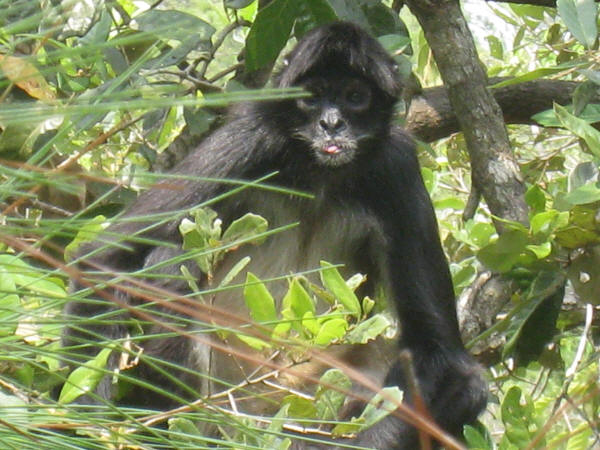
While walking around Caracol, an incredible howling noise
started. It sounded as if the spirits of the Mayans had returned from the
jungle to haunt us. We were finally told these were Howler Monkeys, and
their call can be heard over a mile away. Very eerie! Sounds as if the
creatures making them must be at least as big as elephants!
On our way back to San Ignacio, we stopped at the "1,000
Foot Falls." Actually they are claimed to be 1,660 feet high and the highest
falls in Central America. |
|


|
|
|
|
|
|
|
|
|
|
|
|
El Pilar |
|
|
|
Click on picture to
enlarge image. Click Back to return to text |
|


|
|
After the equally
bone shattering drive back to San Ignacio from Caracol, we decided to
squeeze in a visit to another set of ruins on the outskirts of San Ignacio,
called El Pilar.
The book said that these ruins were mostly un-excavated
and as the road was so rough, rarely visited.
Yes, the road was rough, but a very interesting drive
through forest, farming and ranches.
Only one section of El Pilar has been partially excavated,
so it was an interesting comparison with the well excavated Caracol.
El Pilar is smaller, but the same layout as all the ruins. The forest has
taken over many areas and this makes it a very attractive site whose
mysteries are yet to unfold.
On our way back into San Ignacio, we caught sight of our
first Keel-Billed Toucan, the national bird of Belize. |
|

|
|
|
|
|
|
|
|
|
|
|
|
Xunantunich |
|
|
|
Click on picture to
enlarge image. Click Back to return to text |
|


|
|
Pronounced "Shoenantonich,"
Xunantunich is not far from San Ignacio and only a couple of miles from
Belize's western border with Guatemala. Reached by
crossing the river on a hand operated car ferry, these ruins provide yet
another perspective on the Mayan civilisation.
Although the general geographic and astronomic layout is
always the same, as is the general building structure and purpose, each set
of ruins has its individual design. So it is definitely not a case of
"You've seen one, you've seen them all."
Xunantunich was again very impressive and humbling.
Remember that the Mayans knew about the wheel and even made toys with
wheels, but they never actually used the wheel when building these pyramids.
Each of the ruins is placed on high ground and all offer
fantastic forest views.
|
|

 |
|
|
|
|
|
|
|
|
|
|
|
Blue Hole & Caves |
|
|
|
Click on
picture to
enlarge image. Click Back to return to text |
|


|
|
After our early
morning visit to Xunantunich and a quick Mexican lunch in San Ignacio, we
drove back East to Belmopan, the capital, then turned south back towards
Placencia to visit the Blue Hole National Park. This
drive was all on good paved roads, so the Suzuki held together a little
better.
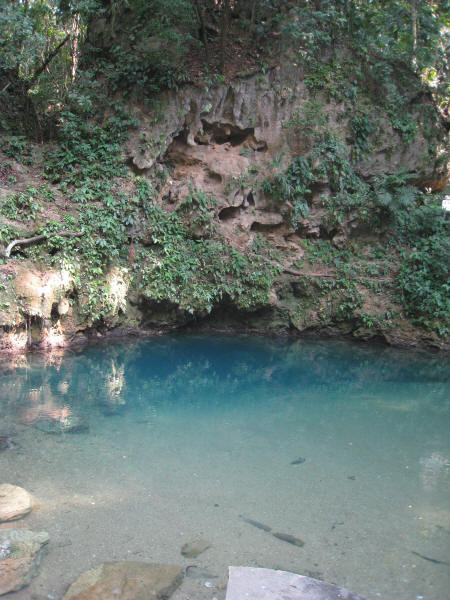
The Blue Hole is a sink hole, reported to be 100 feet
deep, set in the forest.
Not as impressive as other blue holes we have seen, but we
had a very chilling, refreshing dip followed by a brisk 1 mile hike through
the forest before setting off to find accommodation for the night.
There is very little accommodation available on this road,
so we were lucky. Just across the road from the Blue Hole Park was "Ian
Anderson's Caves Branch Lodge." Sounded intriguing.
Ian Anderson is Canadian, who left the hotel trade in
Canada, took up caving, (of which there are many in Belize) and started this
lodge. The main building and restaurant are beautifully built in wood again
reminiscent of many up-market game lodges in Kenya.
The forest cabanas are basic but far more appealing than
those at Parrot's Nest.
Over dinner we met up with a fantastic group of people who
were enjoying caving, abseiling cliffs and waterfalls, dropping into
waterfalls, cave-tubing and much more.
It was great to meet them all and share experiences:
Bobby and Allie
from the USA on their honeymoon.
Alex and Kelly
also from the USA.
Trent and
Christie from Calgary in Canada.
Angela, from New
York, courageously travelling on her own.
Angela joined us the following day on our visit to Belize
Zoo on our way back to Belize City and flight out. |
|


|
|
|
|
|
|
|
|
|
|
|
|
Belize Zoo |
|
|
|
Click on
picture to
enlarge image. Click Back to return to text |
|


|
|
Now having lived in
Africa, seeing animals in their natural habitat and enjoying their freedom,
zoos are usually a no-no for us. However, Belize Zoo
was started by accident when a animal trainer from the US was hired to look
after some "tame" wild animals for a movie being made in Belize. The movie
ran out of money and everyone left, leaving behind the animal trainer and
the animals with nowhere to go.
So she stayed and made a home for them in Belize,
eventually obtaining the present site and official recognition.
The zoo is very well done with animals in as near natural
forested surroundings as possible. All animals are indigenous to Belize.
Many animals are confiscated illegal pets and there is a
program to release certain species back into the wild.
The zoo is educational and hosts schools from all over
Belize.
We took Angela along with us for the trip then she caught
the bus back to Caves Branch Lodge.
We continued on to Belize City, returned the car and flew
back to Brunswick via Miami with great memories of Belize and the people we
met along the way. |
|

 |
|
|
|
|
|
|
|
|
|
back to top |
|
|
|
|
|
|
|
|
|
|
|
|
|
|
|